|
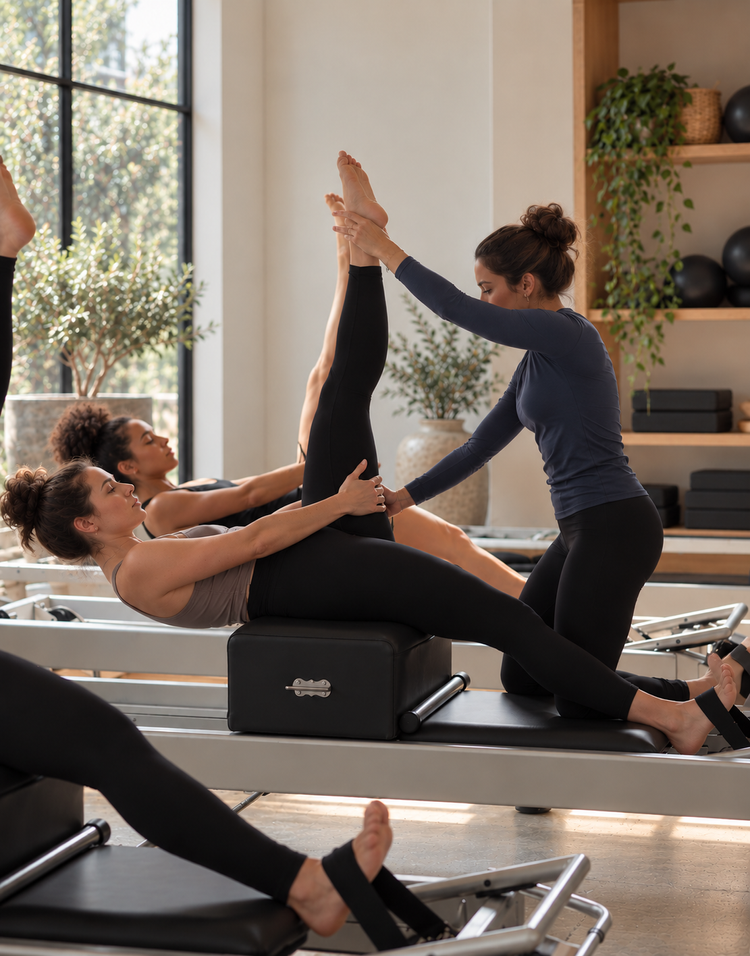
On the Mat, the student must maintain trunk flexion and control the position of the legs without external assistance through the arms. The relationship between leg position, gravitational torque and lumbopelvic control becomes particularly relevant. On the Reformer, spring resistance introduces another set of forces. It assists aspects of trunk positioning while simultaneously increasing the demands on shoulder control and coordination. Neither version is necessarily more difficult. They simply present different challenges. A student who struggles to maintain trunk flexion on the Mat may benefit from the resistance and sensory feedback provided by the straps on the Reformer. Conversely, a student who relies heavily on that resistance may find the Mat reveals a different level of independent control. Equally, we might deliberately choose the Reformer to explore how a student manages forces transmitted through the upper limbs while maintaining the organisation of the trunk. But here's where standardised technique becomes important. To make an informed choice between these versions, we first need to understand what constitutes the exercise itself. If the fundamental technical requirements are constantly changing according to individual teaching preferences, it becomes difficult to distinguish between the demands of the apparatus and the variations introduced by the teacher. A consistent technical reference gives us a common starting point. We can identify which elements of the exercise remain the same, which mechanical demands change, and what those differences might mean for an individual student. It doesn't tell us which version to teach, or how to teach it. That's where the teacher's knowledge, observation and judgement come in. Standardising the technical description isn't about standardising the teaching. It's about giving teachers a reliable foundation from which to make individual decisions.
|