
A Closer Look at Single Leg Circles
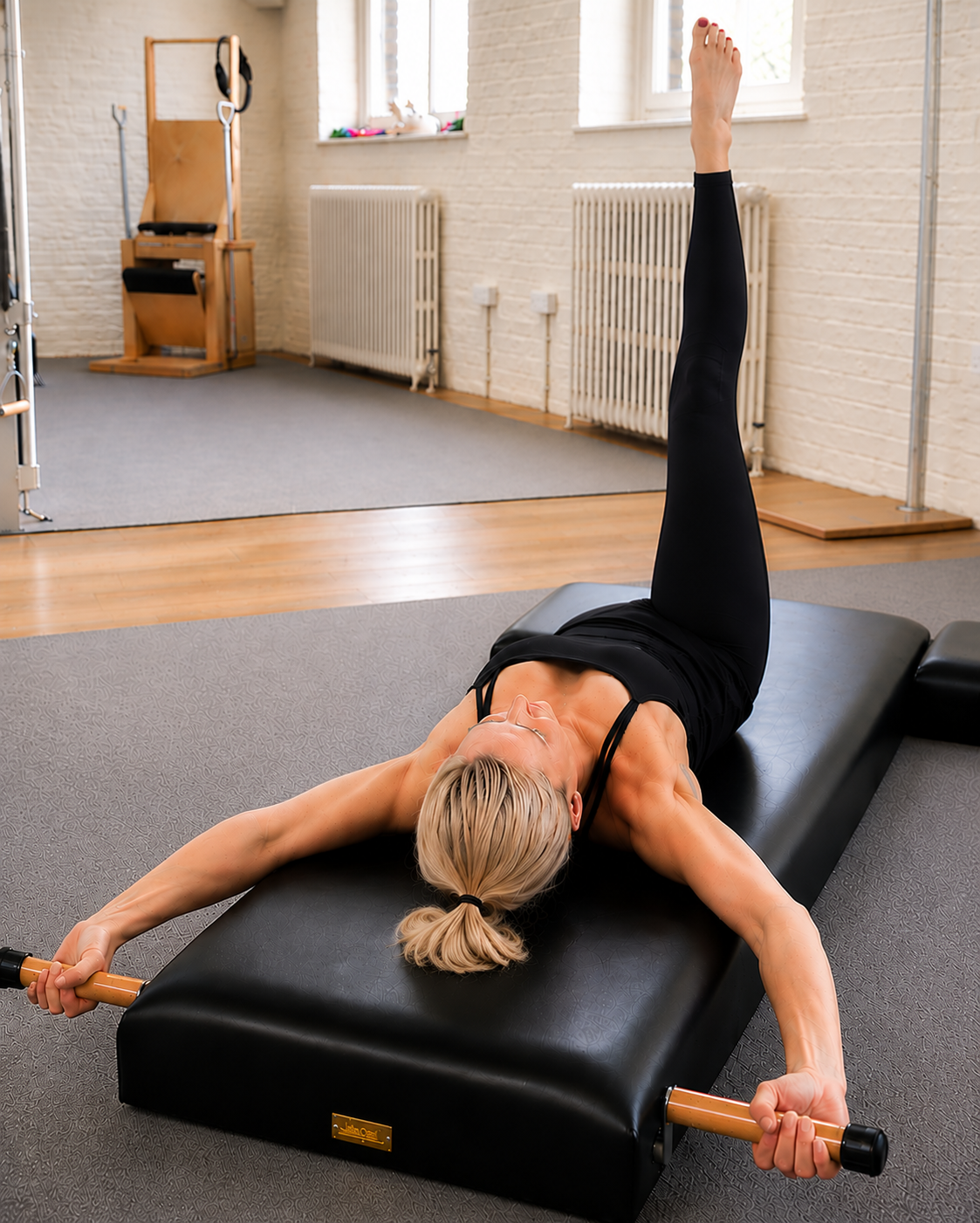
Single Leg Circles looks like one of the simpler exercises in the Pilates Matwork. You lie on your back, lift one leg and draw circles with it. What could possibly require further discussion?
Quite a lot, as it turns out.
It is very easy to concentrate entirely on the leg making the circle. It is the obvious moving part, after all. But Single Leg Circles becomes much more interesting when you start paying attention to everything else.
First, a little history
The exercise appears fourth in Joseph Pilates' original Mat sequence in Return to Life Through Contrology, published in 1945, immediately after The Roll Over and before what he called Rolling Back, which we generally know today as Rolling Like a Ball. Its original published name was The One Leg Circle (Both Ways).
There are some interesting differences between the exercise Pilates demonstrated and the way Single Leg Circles are sometimes taught today.
In Return to Life, Pilates begins lying flat with both legs extended. One leg is brought to an upright, approximately 90-degree position. The raised leg is straight with the foot pointed, while the foot of the leg remaining on the mat is flexed upward.
Perhaps more interestingly, his circles weren't particularly timid.
The original instructions describe the leg travelling across the opposite thigh or ankle and tell the practitioner to swing the legs as far as possible when making the circles. The photographs and accompanying cautions also indicate that the hip on the side of the circling leg can lift as the leg crosses the body.
That's worth knowing because today students are often introduced to this exercise with a very different instruction: don't let your pelvis move.
So which is right?
As usual, I think the exercise is more interesting than a simple rule.
What is Single Leg Circles actually asking you to do?
The obvious answer is to circle one leg.
But if that were all we wanted, we could stand up and wave a leg around.
You are lying on the mat because the rest of your body gives the moving leg something to work from. One leg moves through a relatively large range while you maintain control of everything supporting that movement.
That doesn't necessarily mean making yourself completely rigid. Control and immobility aren't quite the same thing.
What about the other leg?
This is the bit I think we tend to overlook.
The raised leg gets all the attention because it's doing something. Meanwhile, the leg on the mat can easily become something we're simply waiting to use on the other side. It isn't.
In Pilates' original version, he was quite specific about it. The lower leg remained straight on the mat with the knee extended and the toes drawn upwards.
Whether you practise with precisely that foot position or the slightly different leg and foot positions found in later Classical teaching, the underlying idea is useful: the other leg is working too.
Its length and connection into the mat provide opposition to the leg moving above it. Paying attention to that leg can completely change how the exercise feels.
Sometimes the apparently quiet part of a Pilates exercise has rather more responsibility than we give it credit for.
How high should the raised leg be?
Pilates' original starting position places it upright at approximately a right angle to the body.
That doesn't mean everybody's leg will comfortably arrive at 90 degrees with the knee completely straight. Hamstring flexibility, hip mobility and your ability to maintain the position of the rest of the body will all affect where your leg can begin.
For a student, I think the more useful aim is a straight leg at the highest position you can comfortably control without turning the starting position into a battle. As your mobility changes, that position may change too.
How big should the circle be?
This is where things become particularly interesting.
Single Leg Circles are sometimes taught with a very small circle so that the pelvis can remain completely still. That can be a useful way of learning control, but it isn't necessarily where the Classical exercise ultimately ends.
Pilates himself demonstrated considerably more range. His written instructions explicitly describe the leg travelling across the opposite leg, and the accompanying photographs allow movement through the hip as the leg crosses the body.
That doesn't mean the objective is simply to make the biggest circle possible. A huge circle that pulls you around the mat isn't necessarily more accomplished than a small one. But neither do I think we need to make the movement unnecessarily small simply to prove that nothing else moved.
The interesting territory lies between those extremes. Use the range you can control. As your control improves, there may be more range available to you.
Should your hips move?
This may be the question with the least satisfying yes-or-no answer.
If you are learning Single Leg Circles, keeping the pelvis relatively quiet can help you understand the relationship between the moving leg and the rest of your body. But “stable” shouldn't automatically become “frozen.”
Joseph Pilates' own demonstration is particularly useful here. His instructions specifically note that the hip rises during parts of the exercise while the shoulders and head remain on the mat. So pelvic movement isn't necessarily evidence that the exercise has gone wrong.
The more useful question is probably: Are you controlling the movement, or is the movement controlling you? If your leg crosses your body and your pelvis responds as part of a controlled, connected movement, that's rather different from throwing the leg around and being dragged after it.
Does the foot position matter?
Again, the original is interesting.
Pilates instructed the raised leg to be straight with the toes pointed forward and downward. The leg remaining on the mat was also straight, but its toes were drawn upwards.
So the two feet were deliberately doing different things.
That's a small detail, but a useful reminder that Pilates wasn't simply interested in the leg making a circle. He gave very specific instructions for the leg that wasn't moving as well.
Different Classical lineages may teach the feet somewhat differently today, so if you're learning the exercise with a teacher, follow the version they are teaching you and ask why. Those differences are often where some of the most interesting conversations about the method begin.
So what should you think about?
Probably less than this article has just given you to think about.
You don't need to run through a checklist of pelvis, foot, hip, knee, range and breathing every time your leg makes a circle. That would rather defeat the point of learning to move well.
Learn the exercise first.
Then, as it becomes familiar, start noticing what happens beyond the obvious moving part. Can the circle become smoother? Can you use more range without losing control? What happens if you pay attention to the leg on the mat? Can you distinguish between allowing movement and simply being pulled around?
Single Leg Circles is a simple exercise. That doesn't mean there isn't a great deal to find in it.
And perhaps that's one of the nicest things about Pilates: the longer you practise the apparently simple exercises, the less simple they become.