
The Hundred: Action or Result?
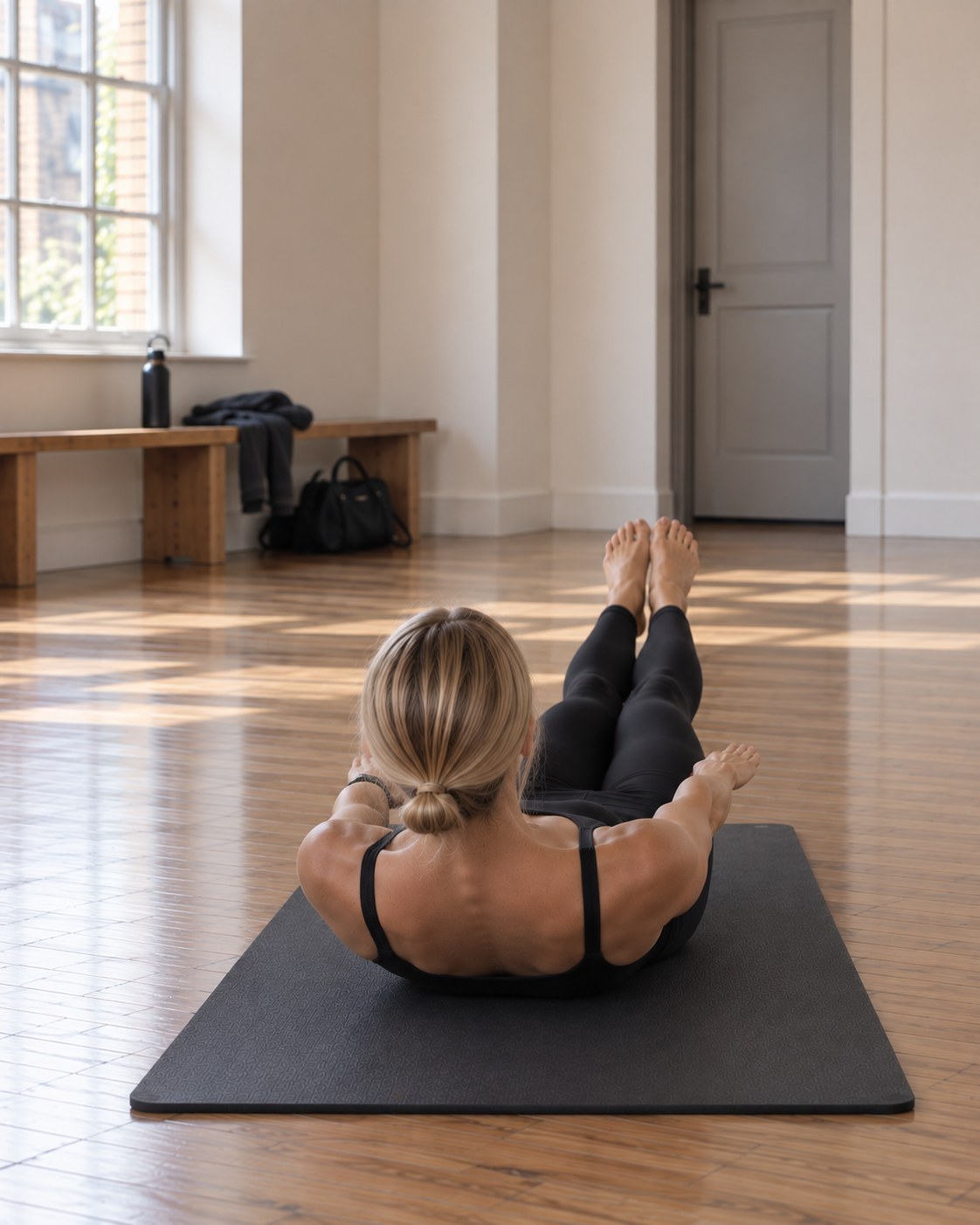
There are plenty of useful ways to describe an exercise. Where the arms are, how high the legs are, the shape of the spine, the distance something travels. These details matter. They give us a shared picture of what we are looking for.
But describing what an exercise looks like is not always the same as describing how we do it.
Take the arm pump in The Hundred. We often describe the arms as pumping approximately six to eight inches. It is a useful measurement and gives us a fairly clear picture of the movement. But I’m not sure that trying to make a six-to-eight-inch pump is particularly useful.
For me, that distance is the result of the action rather than the action itself.
Where is the pump coming from?
It is very easy for the arm pump to become something happening at the shoulders. The arms move up. The arms move down. We keep them straight, make the movement vigorous enough and try to hit roughly the right distance.
The shape may be perfectly recognisable as The Hundred, but we can still ask where that movement is coming from.
When I practise The Hundred, I think much less about moving my arms through a particular number of inches and much more about their relationship to my powerhouse.
As the arms lift, I think out. The reach travels from the powerhouse through the arms and beyond the fingertips.
As the arms pump down, I think in. The movement comes back towards the powerhouse.
Out. In.
The arms are certainly moving, but the intention isn't simply to move them up and down from the shoulder.
Maintain that relationship and the familiar six-to-eight-inch pump appears. The measurement describes what we can see. The connection determines how we get there.
Shape and distance are not necessarily the action
This distinction is useful beyond The Hundred.
Pilates is full of shapes, positions and distances that we can describe quite precisely. That precision is valuable, particularly when we are trying to preserve and communicate a technique. But there is a danger in allowing the visible result to become the action.
If I tell myself that my arms need to travel six to eight inches, I can make that happen quite easily. My shoulders are perfectly capable of moving my arms through that distance.
The same is true of shape. We can put the body into something that looks remarkably close to the shape we are trying to achieve without necessarily creating the action that should produce it.
If instead I ask the arms to maintain a relationship with the powerhouse, the movement has to be organised differently.
The distance is no longer arbitrary and the shape isn't something I have arranged from the outside. Both become consequences of the connection.
And that is much more interesting.
It isn't just The Hundred
Once you start looking for this idea, it appears throughout the method.
Long Stretch is an obvious example. We can describe the shape of the body and the distance the carriage travels, but the exercise becomes much more interesting when we think about the body reaching out from and drawing back into the powerhouse.
The movement has direction rather than simply distance, and the shape of the exercise emerges from the way the body organises itself around that action.
The same principle turns up again and again. What we see externally is often the consequence of something more specific happening internally: opposition, reach, return, connection and direction.
That is one of the reasons I think it is useful to be careful with shapes and measurements. They can tell us a great deal about what an exercise should look like, but they don't necessarily tell us what creates it.
One thing to try
Next time you practise The Hundred, forget about the size of the arm pump for a moment.
Think out as the arms lift and in as they pump down. Let the arms remain connected to the powerhouse and see what distance and shape naturally appear.
Then try it the other way. Deliberately make the arms travel six to eight inches from the shoulders and arrange the body into the shape of The Hundred.
The two versions may look remarkably similar. But the actions that create them are not.